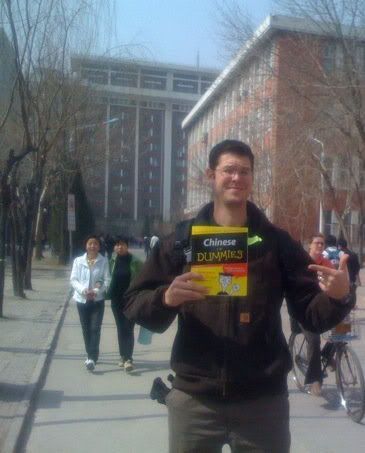
I'm currently jotting down every bit of highly used vocabulary and grammar, its almost essential for me to learn similar words and phrases at the same time so that they aren't confused later. Here is an example that I was mixing up before and was able to piece together yesterday.
zěn me
what?, how?, why?
zěn me le
whats up? whats going on?
zěn me yàng
how about (something) how was it? how are things?
zěn me cái
why are you late ( in doing something)
example: nǐ zěn me cái lái (literal translation: why are you late coming? or arriving)
zěn me can be used in many other ways, just type it in the box at the top left corner (MDBG search box) and see for your self. If anyone has something useful to add don't hesitate.
Like most of you in China I'm studying Mandarin and doubling as a teacher, when you learn how to teach a language you learn the proper way to learn a language. So for anyone not teaching, here is something to absorb:
Yakun and I were walking to the supermarket last night when I told her: "context is something we really need to pay attention to when trying to understand each other, when trying to make a point English speakers like to explain themselves and then say their point, while most Chinese would say their point and then explain."
Earlier on in our relationship I said "I probably wont understand you if your trying to tell me something by "beating around the bush", if you tell me directly it will make life much easier for both of us".
Something Ken Carroll wrote in an article recently put this further into perspective for the both of us. And an article he referred to made me realize, if I'm speaking Mandarin then I need to place more importance on the social situation and implications that it may have contextually.
Whenever we're eating and I'm a little tired from leaning down to the bowl (our table isn't exactly set up according to fēng shuǐ standards) I may set my kuài zi down for a finger fatigue break. Its at this point that she will look over at me and ask "bǎo lē ma?" if its something shes cooked it may have a hidden meaning of "it doesn't taste good?" so when I reply with "no I'm just taking a break" it may sound like "yes, its not very good". Which would result in a disappointing sigh, and my preceding bewilderment.
I give her a lot of credit, shes been very direct when speaking English with me when she wants something and doesn't expect me to just "get it". And even though some may view this as a crutch for me, she is speaking English, and that's the way it should be done (most of the time). When speaking pǔ tōng huà I will keep in mind that I cant and shouldn't be direct as much as I should play with the social context to get my point across.
On an unrelated note, here is a classic Chinese cartoon representing 36 different characters. (thanks to Yakun for finding it)
I had the privilege of meeting Yakuns parents this spring festival in the countryside, we had a great time making traditional foods like jiao zi and mian tiao together. I've been able to make jiao zi a few other times, once at my school so I was able to keep up with the family but I'll show you that another time. Here we are going to learn how to make my favorite soup noodle dish, mian tiao with the help of mom and her massive rolling pin.
Step 1. Add water and flour together, kneading it until its the size of a softball. *Don't add any salt, sugar or egg. Were not trying to grow tumor's or create other unnecessary side effects here.
Step 2. Find a large rolling pin, if there are none of the size depicted in the following video go ahead and break one off from the dining room table. All set? Lets get started!
Step 3. Once you have a large flat piece of dough fold it like origami.
Step 4. Cut with fingers curled inwards.
Step 5. Boil for about the same time it takes to make the spaghetti noodles your used to, its done when it turns from white to yellowish white.
Step 6. Watch the video to see how its done by a pro.
you can add some tomato, cilantro or any other spices and herbs you like, Yakun suggests using these noodles for your spaghetti as well.
Having spent more than a few months in China I can tell you I’m already past the romantic stage of our relationship and on to complaining about who’s going to do the dishes next, no I’m not talking about my dearest Yakun I’m talking about my romantic view of China as it was, but it’s not completely faded.
You've probably noticed that you’re being stared at, and you’re told it’s the curious nature of Chinese people, it shouldn't bother you… But it does, at least when they stare for longer than a period of five minutes while your trying to slurp down that hot bowl of 面条 (miàn tiáo) flour noodles.
Being an uncommon sight it doesn’t help that I also have a local girlfriend, which can promote angry stares from what I presume to be lonely men. I guess it can’t be helped but I want to make the situation more enjoyable for the both of us by poking fun at it, so today I learned a few words to do just that.
What are you looking at?
看你个头?
kàn nǐ gè tóu?
Why are you staring? Is there a flower on my face?
看什么看,我脸上有花儿啊?
kàn shén me kàn, wǒ liǎn shàng yǒu huār á?
The English translation may sound cute, but saying this to a stranger is rude, depending on your tone of voice you could get away with this one but I wouldn’t除非你有种 (chú fēi nǐ yǒu zhǒng ) unless you have the balls.
I finally settled on using this one-liner so I could get back to my meal with out feeling like a jerk.
Can I help you? -or- Do you need something?
有事吗?
yǒu shì ma?
saying this with a kind and humorous demeanor should get you back to a peaceful meal.
Just to cover my self, don't go around using the first two of these carelessly. There, I'm covered!
Something useful that I’ve been meaning to learn is Chinese computer terminology, so after a long hard search on the internet I found a few answers… that were wrong, so then I talked to Yakun, and all was well.
Here are the most basic characters you will need to navigate through the local Internet Café 网吧 (wǎng ba) or Chinese roommate’s computer, thanks to 老婆 (lǎo pó).
Register 注册 (zhù cè)
Login 登录 (dēng lù)
Username 用户名 (yòng hù míng)
Password 口令 (kǒu lìng)
Download 下载 (xià zǎi)
Submit/Publish发表(fā biǎo)发布(fā bù)
Properties 属性 (shǔ xìng)
Delete 删除 (shān chú)
New 新建 (xīn jiàn)
File 文件 (wén jiàn)
Copy 复制 (fù zhì)
Paste 粘贴 (nián tiē)
Undue 返回 (fǎn huí)
Edit 编辑 (biān jí)
Games 游戏 (yóu xì) (for that folder containing all the 网吧 games)
If you think of anything else that may be useful and not easy to understand by simply looking at the UI (user interface) or by context leave a comment and I’ll add it to the list.
Currently my mandarin is at such a low level I should hardly call it basic, so for any advice I give if you find something inaccurate please let me know.
For those of you who’ve yet to take the bus in china let me give you a few pointers based off a recent experience.
If your taking a long distance bus from outside the city chances are its privately operated meaning your going to find dad driving, mom collecting money and the little kid sitting beside her counting cash. If it’s a busy bus like mine many people will be yelling out their stop names and handing over their fair, the amount can fluctuate depending on your destination (something I wasn’t privy to before boarding) confused as to how much it would cost I handed over five yaun to a young man who graciously refused it, so I spoke my stops name quickly “Bīn Jiāng Dào” in hopes he might understand my horrible pronunciation. The driver reluctantly took 5 元 as I looked at my seating options and squeezed into the seat; on the way back I gave 5 元 with out a word. It wasn’t until I arrived home when Yakun told me I should have paid 7 元. I may have profited from my mistake but I’d much rather be understood! Here are some useful tips for riding the bus anywhere you are in China:
If you’re not sure what bus will take you to “Bin Jiang Dao” or whatever your destination you can stand at a bus stop and ask the first bus that pulls up:
Wǒ qù Bīn Jiāng Dào, dào ma? (dào 到 “to go to” or “arrive”)
我去滨江道,到吗?
I’m going to Bīn Jiāng Dào, do you go there?
The answer your looking for is “Dào” if you get a slew of words thrown at you and your mandarin is as basic as mine just take a step on the bus, this will get him squawking even louder if it doesn’t “Dào”. If the bus has a money box don’t put your fair in yet, first look for someone in the front seat collecting money, sometimes they collect the cash in hand, if you find this person simply state your destination again and they will tell you the price otherwise place the money in the box, After the bus driver wipes whatever that crusty substance is off his overgrown finger nail onto his discolored rag choking the stick shift you can scurry to a seat in the middle of the bus, this is going to cause you the least amount of inertia as he weaves in and out of on-coming traffic, it also provides you a position within earshot of the drivers calls.
In order to get off at the correct stop pay attention to the bus driver, he will yell out the name of each stop with a “xià bú xià” at the end.
Xià bú xià 下不下(anyone getting off?)
Xià chē 下车(to get off).
Some other things the driver might say are:
Xià ma 下吗 (anyone getting off?)
Yǒu xià dē ma 有下的吗 (is there anyone getting off?)
Once you hear “Bīn Jiāng Dào, xià bú xià” Yell out “Xià” or “Xià chē” to stop the bus and wake everyone up.
Tonight was a lot of fun, as soon as we arrived at the dock we saw tens of them flying through the sky. At first I even thought "what the heck are those" until I realized what was in my very hand.
We got up to the water front and there were plenty of people selling Kong Ming Deng, when we whipped out our home made lantern heads turned people started talking and we even got a small crowd huddled around us as we lit up the candles, it did fill up with air but it wouldn't take flight, Yakun over heard someone say "I tried to make one so many times but I didn't make it work!" Nevertheless it was fun trying and we got a few good pictures out of it. After that we had even more fun, right when we arrived near someone selling lanterns my eye caught two policeman rounding them up and taking all the Kong Ming Deng!!
I wasn't going to let them ruin the night so with Yakun in hand I dashed to the next salesmen on the dock (it was quite crowded) we looked behind us and there was a policemen right on our heels! Which made it kind of exciting I have to admit... Yakun was screeching "crazy foreigner!" But that was it, I was on a mission to fly!
We reached the next person selling them, as I panicked to get 10 yuan from my pocket Yakun grabbed the first Kong Ming Deng handed to her and before the policeman could stop us we disappeared into the crowd.
It seems they weren't stopping people from lighting them, just the sellers, so we made a circle back to our spot and lit it up, it started to fall at first but the wind picked it up and it flew like an eagle until it was the highest Kong Ming Deng in the sky, our wish is still out there somewhere.